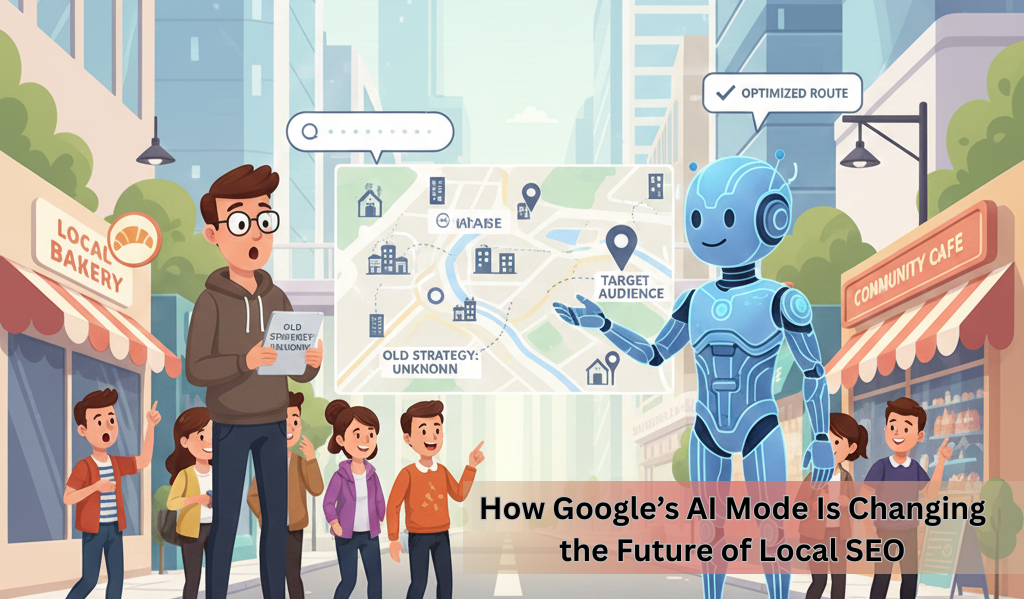
Search has always evolved, but the current shift feels different. With Google introducing AI-driven search experiences, often referred to as AI Mode, the way people discover local businesses is quietly changing. Instead of simply showing a list of links, Google is moving toward answering questions directly, summarizing information, and guiding users toward decisions faster than before.
For local businesses and marketers, this change brings both uncertainty and opportunity. Traditional local SEO practices still matter, but they are no longer the full picture. Understanding how AI Mode works and how it influences local visibility is now essential for staying competitive.
This blog explores what AI Mode means for local search, how it impacts visibility, and what businesses should focus on moving forward.
Google’s AI Mode is designed to improve how users find information by using artificial intelligence to interpret intent and deliver more direct answers. Instead of relying only on keyword matching and ranking pages, the system looks at context, relevance, and trust across multiple sources.
In local search scenarios, this approach becomes even more important. Local searches are often action-oriented. People are not researching for hours. They want quick, reliable answers such as where to go, whom to call, or which option fits their needs best.
AI Mode aims to reduce friction in this process. It gathers information from websites, business listings, reviews, and other online signals to provide a concise response. As a result, users may see fewer options, but those options are more carefully selected.
Local SEO has always been different from general SEO. While general searches focus on information, local searches focus on intent and immediacy. Someone searching for a nearby service usually wants to take action soon.
With AI Mode, Google is not just ranking businesses. It is evaluating which businesses are most likely to satisfy the user’s intent. This evaluation goes beyond traditional ranking factors.
Factors such as clarity of services, consistency of business information, and real-world reputation now play a bigger role. Businesses that communicate clearly and build trust across platforms are more likely to be surfaced in AI-driven results.
For years, local SEO strategies revolved around rankings. Being in the top three results was considered success. While rankings still matter, AI Mode introduces a new layer where relevance and confidence become equally important.
AI systems do not think like traditional algorithms. They attempt to assess whether a business is a good recommendation, not just whether it matches keywords. This means businesses must focus on being understandable and reliable, not just optimized.
Clear service descriptions, accurate business details, and meaningful customer feedback all contribute to this new definition of relevance.
AI Mode relies on a combination of signals to understand and evaluate local businesses. These signals work together rather than in isolation.
One of the most important elements is business clarity. AI needs to quickly understand what a business does, who it serves, and where it operates. If this information is vague or inconsistent, the system may struggle to classify the business correctly.
Consistency across platforms also matters. Business details such as name, address, phone number, and service descriptions should match across websites, directories, and listings. Inconsistent data reduces trust and creates uncertainty for AI systems.
Customer reviews play a critical role as well. AI does not just count reviews. It analyzes the language used, the services mentioned, and recurring themes. Detailed, genuine reviews provide valuable context that helps AI understand real customer experiences.
Content remains central to visibility, but the expectations around content are changing. AI Mode favors content that is helpful, structured, and easy to understand.
Local content should focus on explaining services clearly rather than trying to rank for every possible keyword. Pages that answer common customer questions, explain processes, and set expectations perform better in this environment.
For example, a service page that clearly explains how a consultation works, what problems are solved, and what customers can expect is more useful than a page filled with generic promotional language.
This approach also supports stronger local SEO optimization because it aligns with how AI systems interpret relevance and usefulness.
FAQs are becoming more valuable again, especially in AI-driven search environments. Question-and-answer formats make it easier for AI to extract clear responses and match them with user queries.
However, FAQs must be based on real customer concerns. Generic or forced questions add little value. Businesses should listen to actual customer inquiries and use them to shape their FAQ sections.
Structured information, such as clear headings and logical page layouts, also helps AI systems understand content better. Simplicity and clarity are more effective than complex or overly creative formats.
Even though AI Mode often answers questions directly, websites remain important. When users click through, they expect clarity and ease of use.
A confusing or outdated website can undermine trust, regardless of how well the business appears in search. AI indirectly evaluates website quality through signals such as content structure, mobile usability, and overall clarity.
A well-organized website supports both user experience and AI understanding. This makes ongoing website improvements a necessary part of modern local SEO strategies.
AI Mode is also reshaping how success is measured in marketing. Traffic volume alone is no longer the main indicator of performance. Instead, quality of visibility and intent matter more.
Modern digital marketing services must adapt by focusing on:
This shift encourages marketers to think beyond short-term metrics and focus on long-term credibility and usefulness.
Businesses do not need to overhaul everything overnight. Small, focused improvements can make a meaningful difference.
Start by reviewing how your business is described online. Ensure that services, locations, and contact details are accurate and consistent. Improve service pages by explaining what you do in simple, clear language.
Encourage customers to leave detailed reviews that reflect real experiences. Update FAQs to address common questions honestly. These actions help both users and AI systems understand your business better.
At Mindlabs, the focus is not on chasing every algorithm update. Instead, the goal is to understand how search behavior and technology evolve together.
AI Mode reinforces the importance of clarity, trust, and relevance. Businesses that invest in these fundamentals are better positioned to adapt as search continues to change.
Local SEO is no longer just about being found. It is about being understood and recommended.
Google’s AI Mode represents a meaningful shift in how local search works. While the tools and interfaces may continue to evolve, the underlying direction is clear. Search is becoming more conversational, more selective, and more intent-driven.
Businesses that focus on clear communication, consistent information, and real customer value will remain visible, even as search becomes more AI-driven.
Instead of asking how to rank higher, it is now more useful to ask how to be more helpful. In the age of AI-powered search, that mindset makes all the difference.