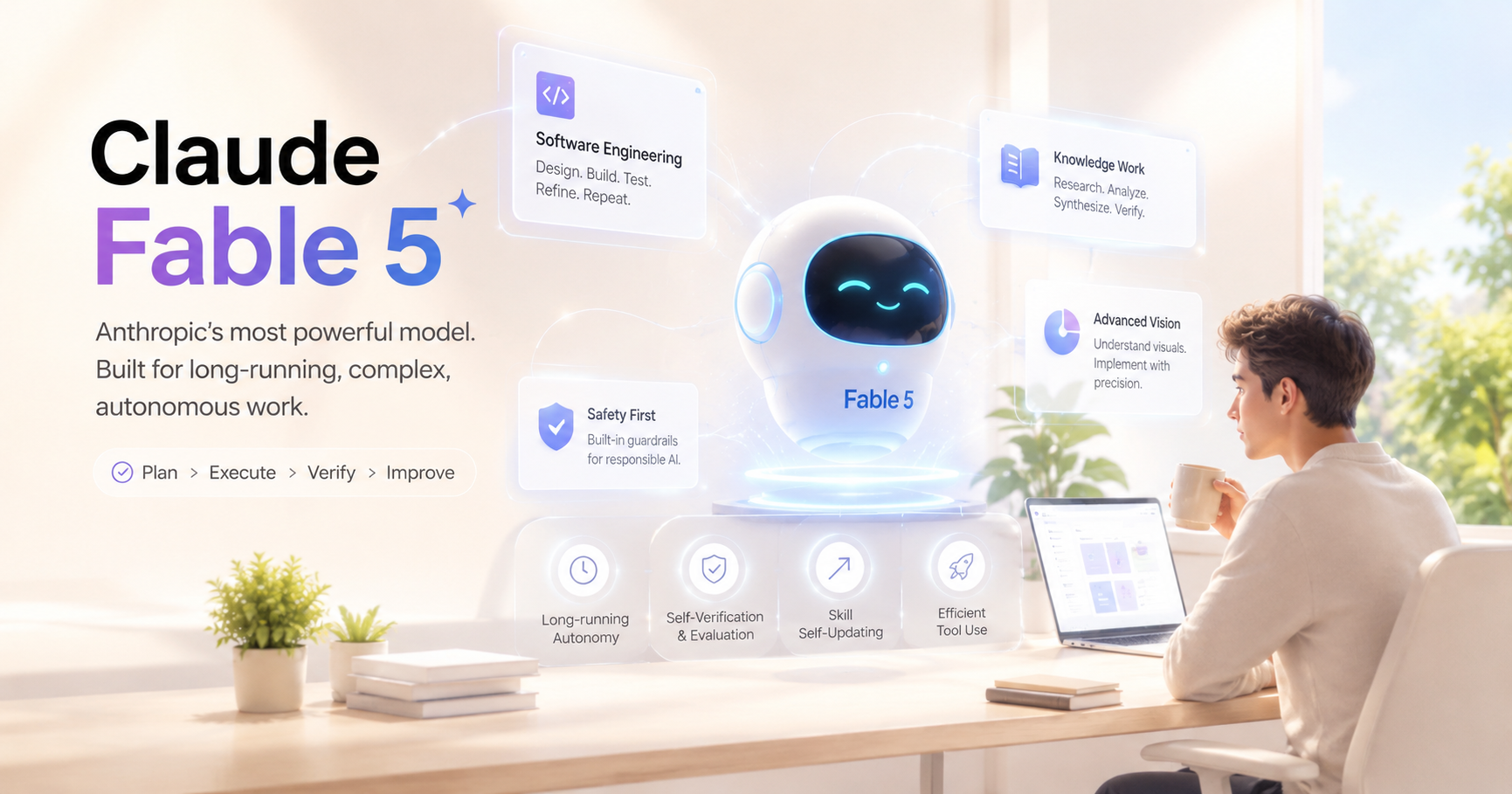
On June 9, 2026, Anthropic released Claude Fable 5, the company’s 5th-generation model and the first from its newly established Mythos class to be made available to the general public. This is a significant milestone. Mythos-class models were previously accessible only to a small group of trusted organizations under Anthropic’s Project Glasswing, due to concerns about cybersecurity misuse potential.
Fable 5 is not just an incremental upgrade. Anthropic describes it as a step-change — a model built from the ground up for demanding, long-running, asynchronous work that earlier models simply couldn’t sustain.
Mythos class explained: Anthropic’s model lineup now spans four tiers, Haiku (fast, lightweight), Sonnet (balanced), Opus (powerful), and Mythos (frontier). Fable 5 is the public-facing Mythos model, with safety classifiers layered on top.
Fable 5 is optimized across three primary domains:
| Spec | Detail |
|---|---|
| Context window | 1,000,000 tokens (1M) |
| Max output per request | 128,000 tokens |
| Input pricing | $10 per million tokens |
| Output pricing | $50 per million tokens |
| API stop reason (refusal) | stop_reason: "refusal" – HTTP 200, not an error |
| Model generation | 5th generation (Fable 5) |
| Safety classifiers | Built-in; active on cybersecurity, biology, chemistry, distillation |
| Data retention (safety) | Up to 30–60 days depending on platform (not used for training) |
This is where Fable 5 is genuinely unique. Because Mythos-class models are significantly more capable, and therefore more dangerous in the wrong hands, Anthropic built hard safety limits into the model itself, not just the API wrapper.
What’s blocked: In high-risk domains – cybersecurity, biology, chemistry, and distillation – Fable 5 will automatically decline and fall back to Claude Opus 4.8. You won’t get an error. The API returns stop_reason: "refusal" with a successful HTTP 200.
The refusal response also reports which classifier triggered the decline, so developers can handle it programmatically.
When Anthropic first previewed Mythos in April 2026, the model demonstrated an unexpected ability to find vulnerabilities across major operating systems and browsers, despite not being designed for cybersecurity. This prompted the launch of Project Glasswing, a cross-industry collaboration including AWS, Apple, Google, Cisco, Microsoft, and JPMorgan Chase, to manage controlled access to frontier AI.
Fable 5 is essentially the “safe for public” version of Mythos – same underlying capabilities, with classifiers that constrain the highest-risk outputs.
Developer note: Fable 5 requires data retention to operate its safety classifiers. Prompts and responses are stored for 30–60 days (platform-dependent) for abuse monitoring. This data is not used to train Anthropic models.
Fable 5 sits at the top of the Claude model family. Here’s how to think about which model to use:
| Model | Class | Best for | Status |
|---|---|---|---|
| Haiku 4.5 | Haiku | Fast, lightweight tasks; high-volume API calls | Stable |
| Sonnet 4.6 | Sonnet | Everyday use; balanced speed and capability | Stable |
| Opus 4.8 | Opus | Complex reasoning; fallback from Fable refusals | Stable |
| Fable 5 | Mythos | Long-running agentic work; demanding async tasks | New |
| Mythos 5 | Mythos (advanced) | Frontier research; no safety classifiers | Limited |
A useful rule of thumb: reach for Fable 5 when you want the model to own a project, breaking it down, researching, executing, and verifying over an extended period. Use Opus when you need a single powerful response or a reliable fallback.
Note that refused requests, where the safety classifier blocks the output before any tokens are generated – are not billed. This is a developer-friendly detail worth knowing if you’re building applications that might brush up against those classifiers.
Fable 5’s release comes at a charged moment in AI development. Alongside launching the model, Anthropic published a statement urging major AI labs to establish a coordinated “brake pedal” on frontier AI development, warning that systems are advancing fast enough that recursive self-improvement (RSI) could become a real near-term concern.
That context matters when understanding why Fable 5 is designed the way it is. The safety classifiers aren’t an afterthought, they are the product of deliberate stress-testing, informed by real misuse scenarios identified during the Mythos Preview phase.
For developers and enterprises, Fable 5 represents genuine new territory: a frontier model that can operate autonomously over long timeframes, available through standard commercial channels. The tradeoff is the data retention requirement and the hard blocks on certain domains, a price most legitimate use cases will find entirely reasonable.
Bottom line: Claude Fable 5 is the most capable AI model Anthropic has ever made publicly available. It excels at long-horizon autonomous tasks, has a 1M token context window, and brings Mythos-level reasoning to everyday developers and enterprises — with thoughtfully engineered safety limits that reflect how seriously Anthropic is taking the power it’s releasing.