The first place people hear about a company online is via the website of that company. This site creates first impressions, gives out information and prompts people to take action. Yet no matter how good the website might have been a few years ago, it may become outdated because of customer needs, technological advancements and the changes in search habits.
Here is an example.
Sarah runs a thriving company which renovates homes. For years, her website successfully brought her many clients. However, recently Sarah noticed that there were fewer enquiries from the site’s contact form. The customers complained that the website was outdated for mobile use, loading of web pages took too much time and that the content was hard to find.
Her reaction to all this was clear: “I need a new website.”
After consulting a few web developers, she was advised to go for redesign or rebuild of the website.
They both seemed to be one in the beginning.
Not really.
Wrong choice could lead to the following – spending extra money on website building, losing some business opportunities or making useless changes. On the contrary, the right choice can result in improved user experience, performance of the website, its SEO and many other factors.
This guide covers the differences between website rebuild and redesign. In addition, you will learn how to make the right choice for your business..
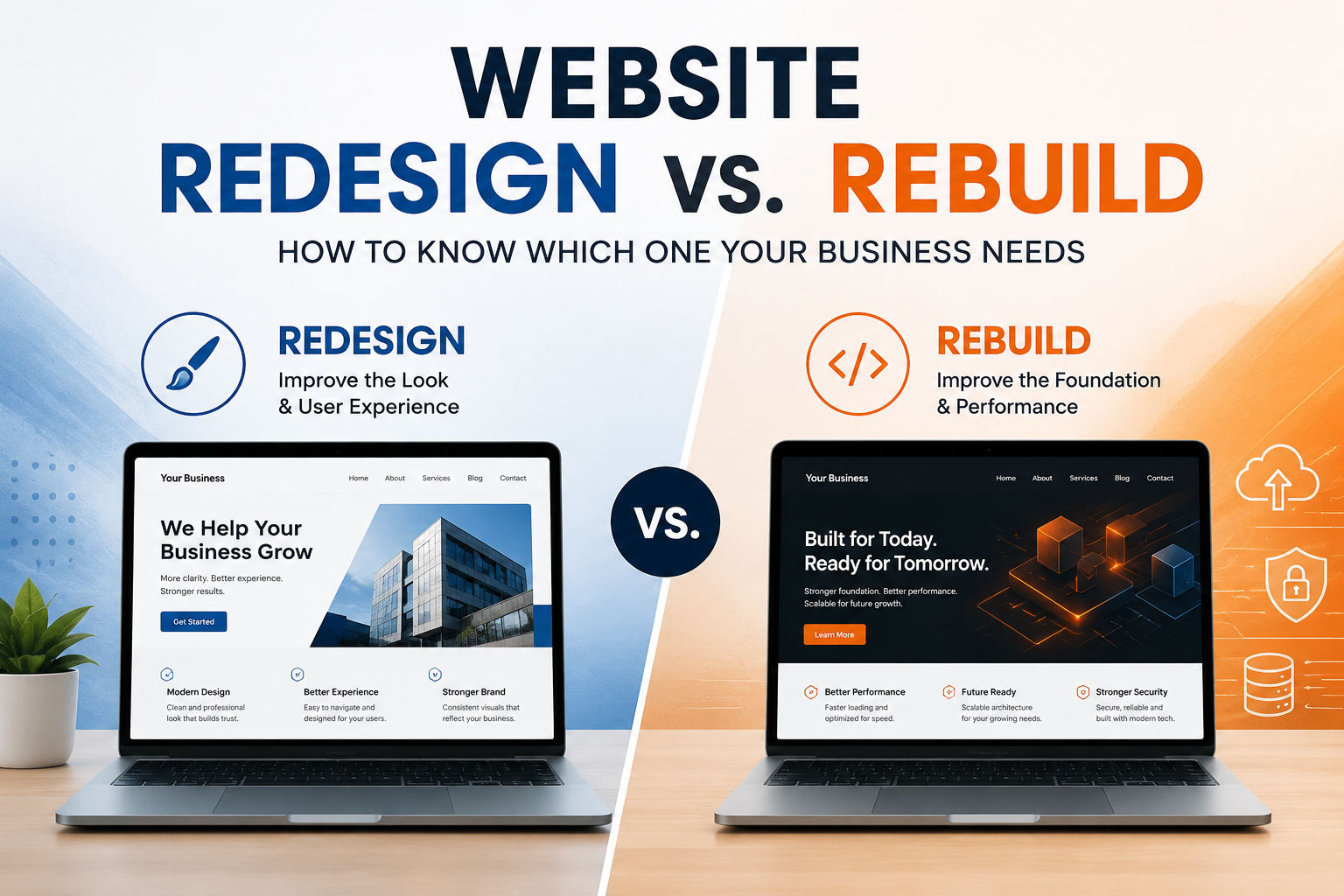
Redesigning your website makes sense when you have an excellent website that just doesn’t look current anymore. Rebuilding your website is something you should consider if there are any technical constraints or performance issues stopping your website from meeting your business needs.
The following table will give you an easy way to determine what’s right for your website.
| If your website… | You probably need… |
| Looks outdated but functions well | A redesign |
| Has slow loading speeds despite repeated fixes | A rebuild |
| Is difficult to update or maintain | A rebuild |
| Needs a fresh visual identity | A redesign |
| Works well but offers a poor mobile experience | A redesign (or partial rebuild if needed) |
| Cannot support new business features | A rebuild |
| Uses outdated technology that creates security risks | A rebuild |
| Has good content but poor navigation | A redesign |
In simple terms:
Knowing the difference will make every other decision much easier.
Website redesign is the process that improves the look, usability, and user experience of an already existing website without rebuilding it.
Imagine building a house. It still stands after the renovation, but you change the colour of the walls, buy new furniture, and make it more comfortable for the people living in it. Website redesign aims to make your website easier to navigate and makes your brand appear more modern and credible.
Redesign improvements include:
Even though these changes can improve the user experience dramatically, the technical structure usually does not change.
Family-operated restaurant had been using the same website for six years.
It is possible to see the menu and make a reservation via the website, but it seems outdated. It is hard to perceive the text on mobile phones, the pictures do not correspond to the restaurant anymore, and the design does not match the branding.
The reservation system operates well. Instead of developing a completely new website, the restaurant just makes it look up-to-date by redesigning the website, adjusting the menu, changing the mobile version, and updating the pictures.
Thus, the website looks modern without changing the same platform and reservation system.
Not all websites need to be built anew. In most cases, the improvements to the user experience will suffice to tackle any issues.
Redesigning the website can be the solution when:
Companies grow and change over time, which means that their logos, colours and messages must be updated on their websites as well.
If you receive many inquiries that are easily answered via your website, improving the user experience might be enough.
Older websites are often not optimized for mobile use, and changing the layout might increase the conversion rate without the need for full reconstruction.
Users tend to determine how credible a company is in mere seconds after landing on its website. This means that out-of-date designs will decrease the credibility, even if the products/services are good.
Minor alterations in usability can have a big effect. These include:
With the technical aspect of the website still being sound, the end result is often very good.
Website rebuild means creating a new website based on a modern technological base by removing old code, system, or architecture that hinder future development. Unlike the website redesign, website rebuild is about how a website works from the inside out.
It can be compared to changing the foundation of a building. The building looks similar from the outside, but its whole construction has been improved.
Website rebuild usually includes:
Despite the extra effort required in planning the rebuild process, it helps companies avoid further maintenance issues.
One manufacturing company created its website almost a decade ago. With time, the firm increased the scope of its services and decided to create customer portals, online quotations, and connect its internal software.
The problem was that it could not be done via the current website. Every single update took many hours because of the compatibility problems. Rather than patching up the old system for further use, the company decided to reconstruct its website with the help of the latest technologies.
The new website was quicker, more secure, and easy to maintain. This is an example of website reconstruction.
Sometimes it is impossible to improve your website through visual enhancements. It may mean you should consider rebuilding.
If changes in image compression, cache usage, and other elements had little effect on performance, it may happen because of the old architecture of your site.
A business owner shouldn’t experience difficulties updating simple content of a website.
If even small adjustments require a developer’s intervention, rebuilding may bring you a significantly better content management system.
With time older platforms don’t get updates.Because of this, they become less secure.
The modern businesses usually have needs such as:
If your site cannot handle these features efficiently enough, rebuilding may be needed.
Companies may waste years paying for minor updates. Finally, rebuilding may become more cost-effective option.
Although both options improve a website, they solve different business challenges.
The table below highlights the key differences.
| Feature | Website Redesign | Website Rebuild |
| Primary goal | Improve appearance and usability | Improve technology and performance |
| Visual changes | Significant | Completely new if required |
| Technical foundation | Mostly unchanged | Completely replaced |
| Development effort | Moderate | High |
| Project timeline | Shorter | Longer |
| Cost | Lower in most cases | Higher initial investment |
| Website speed | May improve | Usually improves significantly |
| Scalability | Limited by existing system | Designed for future growth |
| Maintenance | Existing limitations remain | Easier long-term maintenance |
| Best suited for | Businesses needing a modern look | Businesses facing technical limitations |
This is perhaps the key thing that must be understood:
Redesign involves enhancing the look that people see. Rebuilding involves enhancing the technology behind the look.
The decision to opt for a website redesign or rebuilding must not be based entirely on finances but rather on determining the reason(s) why the site is hindering the growth of the business.
Most entrepreneurs tend to believe that a total overhaul of their website becomes necessary as soon as there is a problem. This however is not necessarily the case, the solution depends on the underlying cause of the problem.
These questions may be helpful in determining whether a website needs to be redesigned or rebuilt. Be as honest as possible in answering the questions and after doing so, it will become clear which path to take.
A website that attracts people but fails to convert leads into enquiries or sales might only need a redesign. Technical issues or bad performance would require you to rebuild the website.
Your website should help with the development of your business, not just be present on the Internet.
Inspect carefully how visitors use your website. Do they contact your company? Fill out forms? Schedule an appointment? Buy anything?
There are cases when the issue is purely aesthetic – your visitors are having trouble locating contact details, pages, call to actions and other things. In this case, a change in website design would help.
But if your visitors leave due to the website’s performance issues and the inability to use certain functions and features, the redesign wouldn’t do any good.
Questions to ask:
In case your website works fine, but it requires better user experience, then a redesign would be all right. But if it doesn’t work, you’ll have to rebuild it.
It should be easy to manage a website. Should the smallest updates require lots of time and always involve developers, then it might be beneficial to rebuild the website.
Companies update their websites regularly with new services, blog posts, employees, offers, and case studies.
Should the process of updating content on the site feel hard, it can mean that the website platform does not suit your needs anymore.
An up-to-date website should make it easy for you to perform all these actions.
When your website functions correctly but is difficult to use on mobile devices, a redesign will most likely help. Rebuilding your website will become necessary if the website does not allow for responsive design anymore.
These days, people find out about different businesses via mobile devices before visiting websites on a desktop PC.
The following are characteristics of a mobile website that functions well:
If you need to improve the layout of your website, redesigning might help.
Sometimes, however, websites that were created in older frameworks cannot deliver a mobile experience due to technological reasons, which makes rebuilding the better option.
Even after trying optimization and not achieving your desired results, it might be wise for you to consider website reconstruction as an alternative.
Website speed impacts both the user experience and ranking on the search engine.
Companies usually start with optimizing the website by either compressing the images, enabling the caching or disabling unnecessary plug-ins. Such measures may make some improvement; however, they can’t solve technical issues.
These include:
Failure to resolve issues even after optimization means that the current website architecture limits the speed. Website rebuilding will give you a chance to build a more efficient website.
If your website cannot scale with your business, then rebuilding is almost always the best option. The needs of your business will probably not remain the same.
For instance, you could be looking to:
All of the above should be done easily without having to incur extra expense and difficulty.
When your existing website makes everything difficult and costly to add, then rebuilding will be the best approach to avoid future trouble.
The purpose of the website is to guide visitors to the needed information easily. In case the navigation process is difficult, a redesign will likely bring the greatest benefit.
The user experience should not be measured by the number of additional pages or effects. User experience should be made simple.
Visitors should know immediately:
If your visitors frequently ask the same questions that are answered on your website, it means that some important information is hard to find.
Some small changes in the design can make a big difference.
For instance:
Many times such changes help to get conversions without rebuilding the whole website.
If maintaining your website costs more money than upgrading it does, you should seriously consider rebuilding it.
All websites need maintenance.
It just depends on how much maintenance is needed to keep the site up and running.
If the work of your developers consists of constant repairing of faulty functionality, incompatibility, or old plugins, you won’t have much time left to make useful upgrades for your business.
Over several years, all these fixes might actually cost you more money than a new approach would. Rebuilding will cost more at first, but will save money in the long run.
In case you remain in doubt about the choice, here is a simple framework for decision-making.
Pick the Website Redesign When:
Pick the Website Rebuild When:
If a few factors listed above apply to your website, rebuilding will yield higher returns in the future.
Choosing between a redesign and a rebuild is only part of the process. Businesses also need to avoid decisions that create unnecessary costs or limit future growth.
Here are some of the most common mistakes.
The modern look of the website does make a positive difference. Yet, when users have to wait for pages to load and face problems with forms, it does not matter how good the website looks visually. It is important to know what the situation looks like from the inside.
It is not necessarily true that the site should be rebuilt. Sometimes companies are ready to invest significantly while they could save money because they think that something new is necessarily better. It might be enough to redesign the website if it is still stable and flexible.
When either redesigning or reconstructing, it is important to preserve all your search optimization benefits. Some key issues to take into consideration are:
A good website project should provide you with higher visibility and not worsen it.
The majority of websites are created to resolve current issues, and forget about future ones. Before starting anything, try to ask yourself some questions like:
Money always matters. However, the cheaper solution is not necessarily the most cost-effective solution.
Though one of the designs seems to be cheaper right now, further down the line the company will have to make costly adjustments because of the technical problems that will not go away.
Rather than asking a question about which solution is cheaper, ask which one solves the problem. This is the better approach.
Let’s go back to a realistic example.
Think of a manufacturing firm that created its website back in 2019. The website continues to generate traffic through search engines; however, recently some problems have emerged.
They include:
Initially, the only solution that comes to mind is redesigning the website. After all, changing colors, pictures, and layout will update the design.
But this is not the core of the problem. The core problem is that the platform itself has become problematic for maintenance and does not meet the future needs of the company.
In this case, it is best to redesign the website in the long run.
Let us take a look at another business now.
An accounting firm has an effective website which has security and speed. But the problems lie in the outdated branding, difficult navigation and a homepage not representing its service offerings.
There are no technical constraints in this case either.
In this scenario, a redesign of the website will be able to provide all the features the business requires without any additional effort that goes into building a website from scratch. The main takeaway is very straightforward:
It all depends on the problem.
Yes, normally the price of website redesign will be lower since it makes use of your existing website and does not involve building a completely new one.
Website redesign implies improving such aspects as visual design, website navigation, and usability, leaving the platform largely untouched. Because of the small number of technical adjustments, the projects tend to be implemented quickly and at a low cost.
In contrast, website rebuild involves creating new architecture, implementing new code, developing database, and switching to a new platform. Though the cost of work is initially higher, it lowers further costs for maintenance and allows for greater business growth in the future.
It all depends on your existing website, rather than your budget.
Yes, it does, but a professional design would always help maintain or even enhance your SEO performance.
Your site may lose some SEO visibility if there is deletion of important pages, URL changes that are not redirected, and valuable content lost in the process.
To avoid risks, companies are advised to:
When done correctly, a website redesign will help you to improve speed, UX and SEO of your site.
Yes. Many companies have managed to revamp their websites without changing the current content management system or platform.
If the existing platform is secure and flexible enough, then it will be enough to change only the design.
Revamping a website can include such components as:
That is, this solution will allow the business to revamp its website image without completely rebuilding it.
There is no set timetable, although most business websites can usually do with a design refresh every two to three years.
Technology, customer expectations, and branding change over time, and regular reviews will make sure that your website keeps up with them.
Rather than scheduling redesigns, watch out for:
Small adjustments done consistently work better than waiting for the site to need a complete overhaul.
In most cases, a rebuild makes more sense when there are technological constraints that do not allow further growth to occur on your website.
Examples are:
Although rebuilding is more complicated, it lays a good foundation for future development.
None of the choices can be said to have an edge from the get-go; the most valuable solution is the one that suits your specific business needs.
Redesign provides high value when you need improvements on usability and brand but the existing site works great.
Rebuild provides higher value when the current site’s technology becomes a hindrance for growth.
Instead of determining which one is the better choice, it would be wise to determine which one solves the most pressing problem in your business.
The site of any company must do much more than just present a good image. It needs to be tailored to meet your requirements and offer a positive experience for users while adapting to the growth of your company.
Selecting between the web site redesign and rebuild does not mean that you choose the bigger project or pay less for the work. This means that you need to know what your website requires now, but also consider the future.
In case your website works great, but it no longer meets your brand identity and user experience requirements, then the website redesign may offer some outstanding results.
However, in case your company suffers because of outdated technologies or other problems, then the rebuild option is worth considering.
Before making any decisions, consider evaluating the performance of your site, its ability to adapt to changes and how well it can achieve your business goals. Going beyond the aesthetics of a website will allow you to make an investment that really counts.
When developing websites at MindLabs Systems, the first step is always gaining an insight into the business behind the site. The team does not propose the same solution to all of their clients; rather, they assess your website’s objectives, technical platform, user experience, and future strategy.
In order to achieve success, you may want to consider your business’s need for either a redesign or a full rebuild of the website.