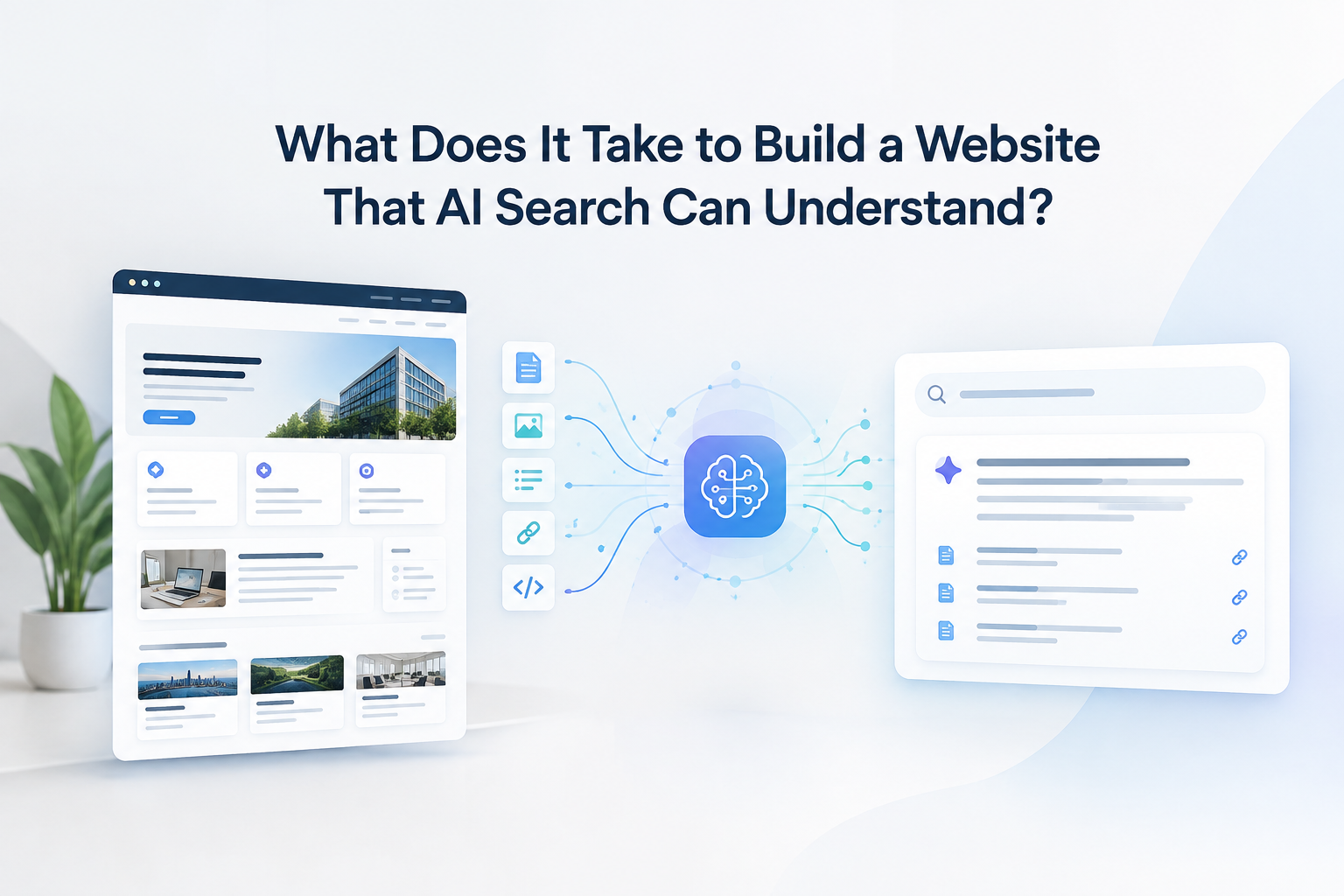
A website used to have one main job: help people find a business, understand what it offers, and decide what to do next.
That is still important. However, the way people discover information online is changing.
Today, people do not always search by typing a few keywords into Google and opening several websites. They may ask a longer question in an AI-powered search experience and expect a direct answer. The answer may then include links or citations to websites that provide useful information.
This creates a new question for businesses:
How can you build a website that AI search can understand and use as a reliable source?
The answer is not to fill a website with AI-related keywords. An AI-ready website needs clear content, a logical structure, accessible information, useful answers, technical foundations, and signals that help search systems understand what the website and its pages are about.
In other words, the goal is simple:
Build a website that is easy for people to understand and easy for search systems to interpret.
An AI-ready website is a website that presents its information clearly enough for modern search systems to understand the business, its content, its services, and the questions its pages can answer.
This does not mean there is a special “AI website” format that guarantees visibility in ChatGPT, Google AI features, Microsoft Copilot, or other AI platforms.
Instead, it means building strong foundations that help both traditional search and newer AI-powered search experiences discover and interpret your content.
An AI-ready website should make it clear:
This is why AI search optimization should not be treated as something completely separate from good website development.
A clear website structure, useful content, good technical SEO, strong internal linking, and a good user experience all continue to matter.
Traditional SEO often starts with keywords.
For example, a business might want to rank for:
website development company
That keyword still has value. However, people may now search in much more natural ways:
These searches are different because they express an actual need or question.
AI-powered search experiences are designed to understand the meaning and intent behind these questions and provide useful answers.
Therefore, a website should not only tell search systems which keywords it wants to be associated with. It should also provide clear answers to the questions its audience is asking.
For example, instead of creating a page that repeatedly uses the phrase “website development company,” a better page could clearly explain:
What does a website development company do?
Then it can explain the development process, technologies, integrations, testing, maintenance, and other relevant areas.
The keyword can still appear naturally. However, the page becomes much more useful because it actually answers the user’s question.
Yes, but clarity matters.
A search system needs to interpret information from a page and understand how that information relates to the user’s query.
That becomes harder when a page has an unclear purpose, vague headings, disconnected sections, or important information hidden behind unnecessary complexity.
A clear page should make its subject obvious from the beginning.
For example, a service page should quickly explain:
What is the service? Who is it for? What problem does it solve? What does the service include?
The same principle applies to blog posts.
If an article is about website redesign, the introduction and headings should make that clear. If a section answers whether a website should be redesigned or rebuilt, the answer should not be hidden several paragraphs later.
This simple approach helps people and machines understand the page more easily.
The best starting point is to write for the person asking the question.
Then, structure the answer clearly enough that search systems can understand it too.
A useful approach is:
Question → direct answer → explanation → example → supporting information
For example, if the question is:
Does SEO still matter for AI search?
Start with the answer.
SEO still matters because AI-powered search experiences depend on discoverable, understandable web content. Technical accessibility, useful content, clear page structure, and other established search fundamentals remain important.
Then explain why.
This is better than spending several paragraphs discussing AI search before finally answering the question.
When writing content for an AI-friendly website:
Most importantly, do not write content only because you think an AI system might cite it.
Write something worth citing.
People often ask AI systems questions in complete sentences.
Instead of searching for:
website redesign
someone may ask:
How do I know if my business website needs a redesign?
Instead of:
AI search SEO
they may ask:
How can I make my website easier for AI search engines to understand?
These natural questions reveal user intent.
That gives businesses a useful opportunity. Rather than guessing every keyword a customer might type, they can identify the questions customers genuinely ask and create useful content around those questions.
Some questions worth considering include:
These questions should not simply be added as a list of keywords.
They should become useful sections where the questions naturally fit.
Content is only one part of an AI-friendly website.
The website itself also needs a clear structure.
Think about a website as a connected information system.
The homepage explains the business. Service pages explain what the business provides. Blog posts answer specific questions. About pages explain the company. Contact pages provide ways to get in touch.
Internal links connect these pieces.
When these relationships are clear, visitors can move through the website more easily. Search systems can also better understand how different pages relate to one another.
A strong website structure usually includes:
This is also where website design and development decisions become important.
A website that looks modern but has confusing navigation is still difficult to use. Similarly, a website with good content but a weak technical structure may not provide the experience a business needs.
If you are unsure whether an existing website needs improvements or a complete rebuild, it is useful to understand the difference between the two approaches. MindLabs explains this in more detail in its guide on [Website Redesign vs. Rebuild: How to Know Which One Your Business Needs].
Structured data gives search engines additional information about the content of a page.
In simple terms, it provides machine-readable details that help describe what a page represents.
Depending on the website, this may include information about:
For example, an article can use structured data to identify information such as its headline, author, publication date, and other article details.
However, structured data should not be treated as a shortcut to AI citations.
Adding schema does not guarantee that a page will appear in an AI-generated answer.
It is better to think of structured data as one part of a larger website foundation.
The page still needs useful content, clear structure, technical accessibility, and information that genuinely answers the user’s question.
There is no simple formula that guarantees an AI citation.
However, businesses can make their content more useful to search systems by making the information clear, specific, trustworthy, and easy to verify.
Consider a page that says:
“Our technology solutions help businesses grow.”
That sounds positive, but it does not provide much specific information.
Compare it with a page that explains:
“A business website can support lead generation by making services easy to understand, answering common customer questions, and providing clear paths to contact the company.”
The second statement provides more useful information.
Strong content often has several characteristics:
The reader should not have to search through a long introduction to find the answer.
Avoid vague statements when a clearer explanation is possible.
Add experience, examples, processes, observations, or information that is genuinely useful.
When making factual claims, use reliable sources and make it clear where the information comes from.
Answer the main question, but also address the related questions a reader is likely to have.
Important information should be reviewed when circumstances change.
This matters because AI search is increasingly being measured in terms of which pages are used as sources. Microsoft, for example, now provides AI Performance reporting in Bing Webmaster Tools that shows publishers which URLs are cited in supported AI-generated answers and which queries are associated with those citations.
That makes one thing clear: being a source is becoming a measurable part of search visibility.
Sometimes the problem is not that a business lacks useful information.
The problem is that the information is difficult to find or interpret.
Common issues include:
For example, imagine a service page where the actual description of the service appears halfway down the page, while the first several sections contain generic marketing statements.
A visitor may become confused.
A search system may also have less clear information to work with.
The solution is not always to add more content.
Sometimes, the better solution is to make the existing information clearer.
Yes.
AI search does not mean traditional SEO has suddenly become irrelevant.
Search engines still need to discover, crawl, interpret, and retrieve information from websites.
That means technical SEO and content fundamentals remain important.
A practical AI-search strategy should therefore bring several areas together:
Technical SEO + useful content + clear structure + internal linking + website usability + trustworthy information
These areas support one another.
For example, creating an excellent article is less useful if the page cannot be properly accessed or discovered.
Likewise, having a technically sound website is not enough if the content does not answer the questions customers actually have.
AI search adds another layer to the discovery process, but it does not remove the need for a strong website.
MindLabs has also explored how AI platforms can influence the way people discover businesses and products in its article, [Which AI Is Actually Bringing You Customers? The Truth About AI Search Results].
You do not need to rebuild an entire website simply because AI search is growing.
Start with the basics.
Look at your homepage, service pages, product pages, about page, and important blog posts.
Ask:
Can someone understand the purpose of this page within a few seconds?
Talk to your sales and support teams.
Review customer emails, support requests, search queries, and conversations.
Look for repeated questions.
Those questions can become valuable content topics.
Do not make readers work to find the answer.
Give the short answer first, then provide the details.
A heading such as:
Why This Matters
is less useful than:
Why Website Structure Matters for AI Search
The second heading tells the reader exactly what comes next.
Use internal links where they genuinely help readers move from one topic to another.
Make sure important pages can be crawled and indexed and that important information is not unnecessarily hidden.
A website should work well on the devices people actually use.
Add relevant structured data that accurately describes the page. Do not add markup simply because you think more schema will automatically produce better visibility.
Do not simply rewrite information that already exists on hundreds of websites.
Add something useful.
Review important pages when services, products, processes, statistics, or other key information changes.
Not necessarily.
AI search can be one reason to review a website, but it should not automatically be a reason to rebuild one.
First, identify the actual problem.
If the website already has a strong technical foundation, clear navigation, useful content, and a good user experience, targeted improvements may be enough.
On the other hand, a deeper website redesign or rebuild may make sense when several fundamental problems exist.
For example:
This is where an experienced web development team can help assess the situation before recommending a solution.
At MindLabs, the focus can be on understanding what the website actually needs rather than assuming that every business needs to start from scratch.
Before publishing new content or planning a website update, ask these questions:
If the answer is “yes” to most of these questions, the website already has many of the foundations needed for modern search.
First, ensure that your website is easily crawlable, comprehensible, and navigable. Then you should provide relevant content which will answer the questions that your target audience has. Good technical SEO, useful internal links, good headings, accurate data and suitable structure data might help with that.
An AI-based search system will extract information from the source and interpret it in order to give an answer to the user’s question.
While AI search experiences may be able to leverage information that comes from websites, visibility cannot be guaranteed for all pages or websites. The crawlability, indexing, quality and relevance of the content, as well as the process through which an AI system can obtain information can impact the visibility of a page.
It is impossible to guarantee an AI citation for your website. One way to achieve this is to create clear, factual and helpful information that answers questions related to a topic.
Yes. AI-driven search is still based on the crawling and understanding of the content of websites. So technical SEO, crawlability, good content, internal links, and proper website structure are still relevant.
Structured data may assist in understanding the contents and entities represented on the pages for search engines. Nevertheless, structured data does not necessarily mean that your site will be mentioned in an AI-generated answer.
There are several possible reasons. Your content might not be relevant to the question being asked, your page might be harder to discover or access, the subject matter might have better sources, or the AI system might simply be using other sources for that particular question. There is no one thing that will guarantee inclusion.
Not necessarily. You first need to analyze the content, structure, and technical aspects of your website, as well as its usability and capability to respond to customer inquiries.
AI search is changing how people discover information, but the basic principle remains surprisingly simple.
People want clear answers.
Search systems need clear information.
Businesses need websites that explain what they do and help the right people take the next step.
So, instead of trying to create a website specifically for one AI platform, build a website with strong fundamentals:
Clear content.
Useful answers.
Logical structure.
Accessible information.
Good user experience.
Reliable information.
Strong technical foundations.
When these pieces work together, your website becomes easier for people to use and easier for search systems to understand.
And that is a much more sustainable approach to preparing for the future of search.